
Built for us. Adopted by a trade we don't practise.
TimePilot started from an internal irritation: knowing, at the end of a project, whether we had made any money on it. Six days after the first screen, an architecture practice was logging its hours in it, in production. The same engine now carries two business models with nothing in common, with no separate version.
- Duration
- 6 days to production · 4 months of continuous evolution
- Sector
- SaaS · Time tracking and profitability
- Size
- 2 companies in production · 9 users
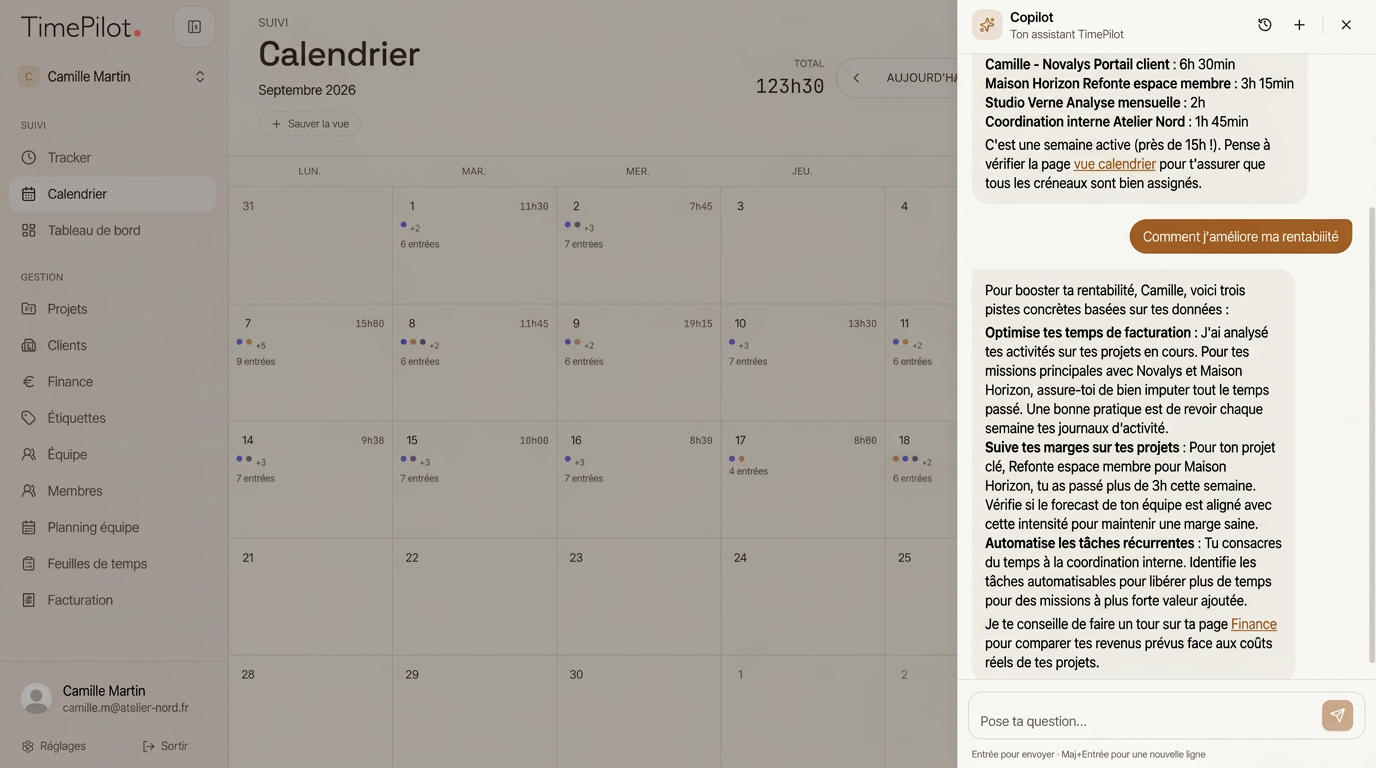
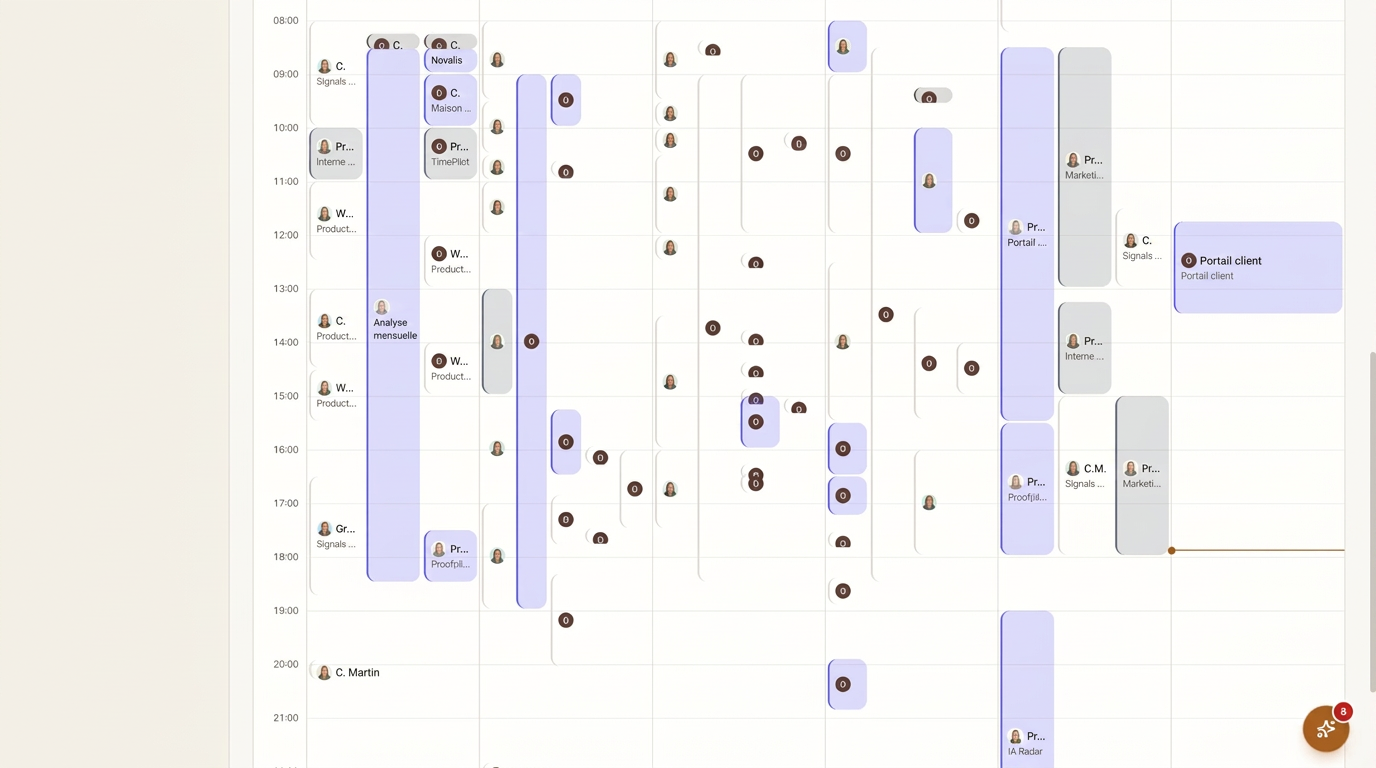
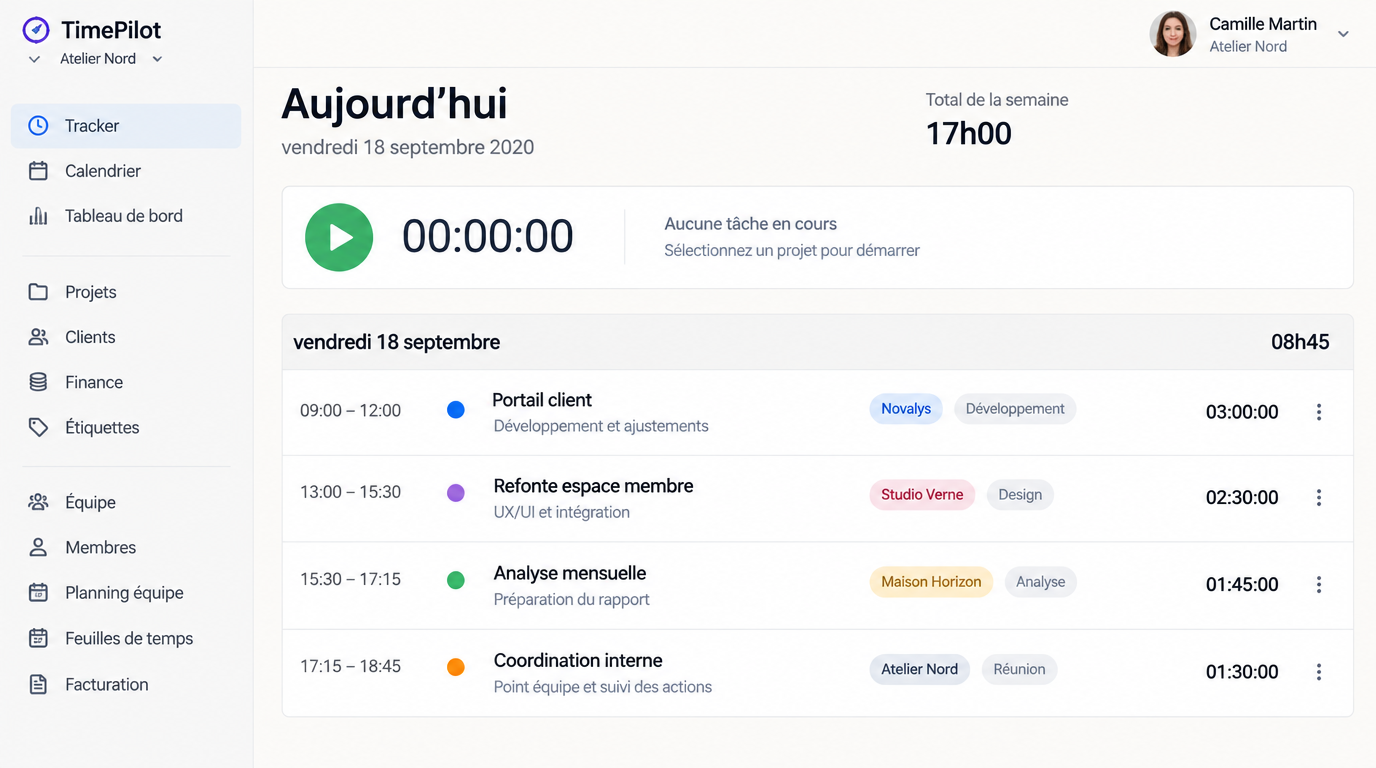
An immediate entry, attached to the right project and the right client.
- Construction base
- The value of the works on which an architect's fees are calculated. It evolves as the site progresses: estimate, measurement, tender, final account. Every revision is kept rather than replacing the previous one.
- Phase share
- The percentage of fees attached to one step of the brief. For an architecture practice: preliminary design, permit, construction drawings, site works, handover. The shares must land on exactly 100 %, which the database checks itself.
- Historised hourly cost
- What a person costs on a given date. An hour from June stays valued at June's cost even after a raise in September, otherwise past profitability would change retroactively.
TimePilot
TimePilot's first client was us. An agency that sells time needs to know what that time cost, phase by phase, while the project is running, not three months later. The second arrived almost immediately: an architecture practice. Same hours to log, an entirely different way of getting paid.
How did it work before?
Hours lived in a spreadsheet, profitability was worked out afterwards, and nobody could say mid-course whether a phase was eating its margin. Market tools know how to run a stopwatch; they don't answer « is this project still making us anything today ».
This was not about building another stopwatch. Three things had to be connected that nobody connects: the hour logged, the phase it belongs to, and the money that phase actually earned. The day an architecture practice wanted the same tool, the question became: does this hold up for someone who isn't us?
Step by step.
- Start
An irritation, not a specification
The project starts from one question that had gone unanswered for months: what did this job cost us. The first screen is a time entry attached to a project and a phase, nothing more.
- Production
An outside user within six days
The first architecture practice logs its hours six days after the project was created. From then on, every product decision is made with a real user in front of us, on real data.
- Profitability
Margin you read while the project runs
Every entry is valued at the hourly cost in force on its own date, never today's: giving someone a raise doesn't rewrite six months of history. Margin, budget consumption and a health status read out per project and per phase.
- Second trade
The architect's brief, with no separate version
Architects' fees are split into shares across a construction base that moves as the site progresses. The engine absorbed that model alongside time-and-materials, in the same code, with a split exact to the cent.
- Traceability
What is written is not rewritten
The construction base is insert-only: a revision creates a new dated line, it never overwrites the previous one. The fees applicable at any past date remain reconstructable.
- Confidentiality
Amounts aren't merely hidden
Financial columns are not served to users without read rights: not blank on screen, absent from the response, including outside the application. Margin confidentiality doesn't depend on how the interface behaves.
What is measurable.
- 6 dFrom the first screen to the first hour logged in production
- 2Companies in daily use, with two different business models
- 212Project phases tracked, across 70 projects and 55 clients
- 3Languages shipped from day one: French, Dutch and English
Not (yet) ready to talk?
Try the AI Radar first : a free AI diagnostic in 10 minutes, with a prioritized roadmap as outcome.
What follows.
TimePilot keeps evolving with the two companies that use it every day, and nothing in its foundation assumes they are an agency. It is the most direct demonstration of what we sell: software cut for a precise context, but built to outlive that context.
A context close to yours?
Scope, timeline and price in writing within 5 business days, before any commitment.
Describe your trade.
We'll show you the tool.
30 minutes to understand your need, then a scope, a timeline and a price in writing within 5 days. And a prototype before any commitment.